🎮 Sworn - Regression Testing Case Study (PC Game Pass Edition)
🧾 About this work
- Author: Kelina Cowell - Junior QA Tester (Games)
- Context: Self-directed manual QA portfolio project
- Timebox: 1 week
- Platform: PC (Xbox Game Pass) • Windows
- Build: PC Game Pass Build: 1.01.0.1039
- Focus: Change-driven, risk-based regression testing (golden-path stability, save/load integrity, core menus, and high-risk UI overlays)
Introduction
One-week, change-driven regression pass on Sworn (PC Game Pass, Windows, build 1.01.0.1039) focused on golden-path stability (launch → play → quit → relaunch), save/load integrity, core menus, audio sanity, input handover, and areas plausibly touched by the latest public Steam patch notes. This was a solo, portfolio-only project using SteamDB patch notes as an external oracle, without claiming parity with the Steam build.
- Scope: Change-driven, risk-based regression on the current PC Game Pass build. Coverage focused on golden-path stability (launch → play → quit → relaunch), save/load integrity, core menus, audio continuity, input handover, and any areas plausibly touched by the latest public patch notes. SteamDB notes were treated purely as an external oracle for context, not as a source of parity requirements.
- Approach: One-week solo pass executed through a Regression Matrix and a time-boxed Session Log. Each check was mapped to either a patch-note reference or a baseline risk area. Sessions documented clear anchors and expected outcomes, with targeted rechecks only where additional clarification was needed. Accessibility findings from Day 0 (SWOR-1 to SWOR-4) were consolidated into a single A11y cluster in the Matrix because no newer build existed to re-test them.
- Outcome: The Regression Matrix produced a balanced view of this build’s stability: 8 passes, 1 fail, 1 not applicable, and 1 known A11y cluster. Six total defects were logged: four onboarding accessibility-prompt issues (SWOR-1 to SWOR-4), one post-death flow defect where the Defeat overlay blocks Stats and Continue begins a new run (SWOR-6), and one low-contrast Blessing choice prompt (SWOR-15). Together they outline the key flow and A11y risks on the current build.
- Evidence: Google Sheets workbook (README, 1-liner summary, Regression Matrix, Session Log, Bug Log, STAR Summary, Glossary) plus OBS/Xbox Game Bar recordings uploaded privately to YouTube. Evidence is grouped by area (baseline flow, settings, save/load, death flow, audio, Enhancements, power-ups, Alt+Tab, input handover, economy), with the Matrix and Session Log cross-linked so reviewers can jump directly to the exact clip or log entry.
| Studio | Platform | Scope |
|---|---|---|
| Windwalk Games/Team17 | PC Game Pass (Windows) | One-week, change-driven regression: golden-path stability • autosave Continue & save/load integrity • settings navigation & persistence • death → Stats → hub flow • audio continuity/settings • Enhancements/Codex readability • power-up next-room behaviour • pause/Alt+Tab • controller ↔ KBM handover & hot plug • onboarding A11y prompt cluster tracked as known issues (SWOR-1–4). |
🎯 Goal
Show how I run a realistic one-week, change-driven regression pass: using SteamDB patch notes to target checks, validating high-risk systems on the PC Game Pass build, keeping the golden path stable, and documenting six bugs (including an onboarding A11y prompt cluster and a death-flow defect) with concise repro steps, STAR summaries, and clear evidence.
🧭 Focus Areas
- Golden-path flow (launch → play → quit → relaunch)
- Autosave Continue and basic save/load integrity
- Settings navigation and persistence
- Audio checks and music continuity
- Death → Stats → hub behaviour (defect SWOR-6)
- Enhancements & Codex readability and behaviour
- Power-ups and next-room effects
- Pause menu, Alt+Tab sanity, windowed/fullscreen
- Controller ↔ mouse/keyboard handover and one hot plug
- Onboarding A11y prompt cluster (SWOR-1–4) tracked as known issues on this build (no new build to re-test)
📄 Deliverables
- Regression workbook (README, 1-liner summary, Regression Matrix, Session Log, Bug Log, STAR Summary, Glossary)
- Bug log and STAR summaries for six defects (SWOR-1–SWOR-4, SWOR-6, SWOR-15)
- Evidence videos grouped by area (YouTube playlist)
- Jira-style defect summaries matched to workbook IDs
- Clear traceability linking each check to SteamDB patch notes and risk areas
📊 Metrics
| Metric | Value |
|---|---|
| Total Bugs Logged | 6 |
| Critical | 0 |
| High | 0 |
| Medium | 5 |
| Low | 1 |
| Repro Consistency | 100% |
⭐ STAR SUMMARY – Sworn Regression QA (PC Game Pass)
Situation: One-week, change-driven regression pass on Sworn (PC Game Pass, Windows, build 1.01.0.1039). The SteamDB patch notes for v1.0.3.1111 were used as an external oracle to guide what areas might reasonably need rechecking, without claiming parity between platforms.
Task: Validate that key systems on the PC Game Pass build behaved correctly after upstream changes - golden-path stability, save/load, settings persistence, audio, death-flow logic, Enhancements/Codex behaviour, power-ups, Alt+Tab, and input handover – and keep previously identified onboarding accessibility issues visible as a known risk cluster on this build.
Action: Built a Regression Matrix mapped to patch-note items and baseline risks, then executed targeted sessions across the week. Each check was time-boxed with clear anchors and expected outcomes, and marked as Pass, Fail, Not applicable or Known issue. All evidence was captured using OBS/Xbox Game Bar and logged into a structured Google Sheets workbook with a Bug Log (six defects: SWOR-1–SWOR-4, SWOR-6, SWOR-15), STAR Summary and fully linked Session Log.
Result: The Regression Matrix outcome was 8 passes, 1 fail, 1 not applicable and 1 known A11y cluster. Most areas passed as expected, including launch→play→quit→relaunch, autosave Continue, settings navigation/persistence, audio continuity, Enhancements/Codex behaviour, power-up behaviour, Alt+Tab, and controller↔KBM handover with one hot plug. One regression-relevant defect was confirmed: SWOR-6 (Defeat overlay remains foregrounded, blocking Stats, and Continue starts a new run). A small visual-readability issue in the Blessing choice screen (SWOR-15) was also documented. Onboarding accessibility prompt issues (SWOR-1 to SWOR-4) are tracked in the bug log as a single A11y cluster on this build, but were not re-run in new sessions because no newer build was available.
🤝 Networking & Applied Insight
During this project I didn’t guess the scope in isolation. I shaped the regression plan around targeted guidance from senior QA professionals, treating this as a miniature live-ops assignment instead of a theoretical exercise.
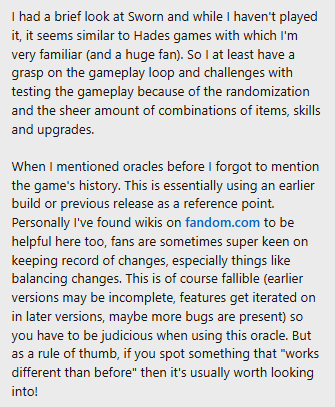
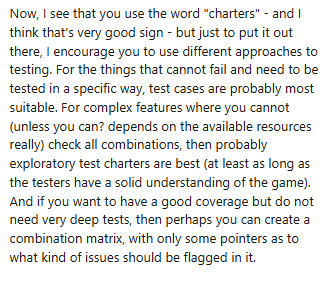
Conrad Bettmann (QA Manager at Rovio Entertainment) emphasised four principles for realistic regression work:
- Map regression to where the game actually changed using multiple oracles such as patch notes, changelogs, community reports and, where useful, historical behaviour from earlier builds or fandom wikis.
- Prioritise must-not-break systems such as save/load, session flow, input ownership and menu stability.
- Match the test approach to the surface: scripted test cases for critical flows, exploratory charters for large or complex spaces, and lightweight matrices for broad variable sets that don't need deep test-case detail.
- Keep the suite maintainable so each check traces directly back to either a patch-note change or a genuine risk area instead of becoming a full re-test of the entire game.
I applied this by redesigning my Regression Matrix so that every entry ties to a specific change, a stability requirement or a coverage slice. For Sworn, historical-oracle references were not required because the SteamDB patch notes already provided sufficient clarity on what had changed.
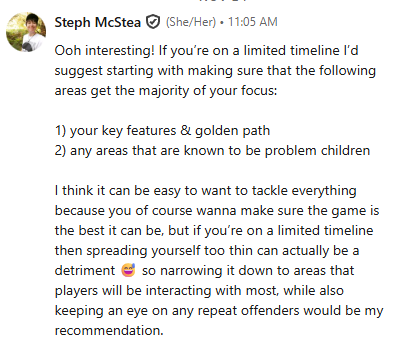
Steph McStea (QA Lead at Double Eleven) reinforced the importance of focusing on the golden path and known “repeat offender” areas when time is limited. Instead of touching every system in Sworn, I centred the regression on what most players hit every session and gave extra attention to clusters already known to be fragile from earlier testing. This kept the plan achievable for a one-week solo regression while still mirroring how real studios prioritise player-impacting surfaces.
Their combined insight directly shaped how I scoped the project, the way I structured my Regression Matrix, how I prioritised checks like death-flow logic and UI readability, and how I presented evidence. It ensured the final case study reads like a focused, change-driven regression effort rather than a wide, undefined testing sweep.
| Source | Key takeaway | How I applied it in this project | Evidence |
|---|---|---|---|
|
Conrad Bettmann QA Manager, Rovio Entertainment |
Regression should be change-driven, risk-based and traceable. Use multiple oracles appropriately: patch notes, changelogs, known issues, and—when relevant—historical behaviour from earlier builds or fandom wikis, while understanding their fallibility. Choose the right test method for the surface: test cases for non-negotiable flows, exploratory charters for complex behaviour, and matrices for broad variable spaces. |
|
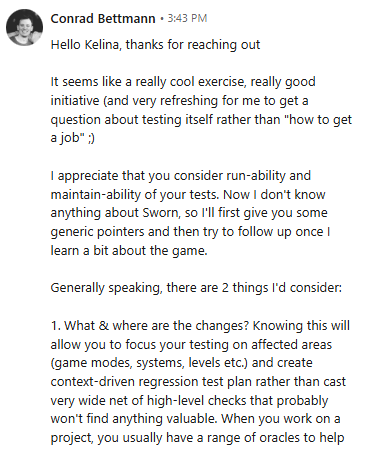
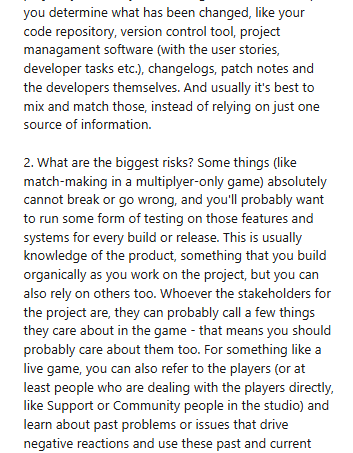
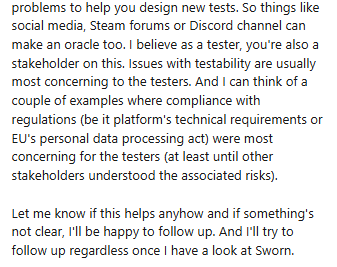
 Click to enlarge
|
|
Steph McStea QA Lead, Double Eleven |
Focus regression on what players hit most often and areas known to cause repeated issues. Keep the plan realistic for a one-week assignment by prioritising golden-path behaviour and known fragile surfaces rather than wide exploratory testing. |
|
 Click to enlarge
|
📷 Evidence & Media
These links are the complete artefacts for this project. They contain:
- Overview and scope
- Charters and session notes
- Bug log and STAR summary
- Daily smoke runs and outcomes
- Device and network matrix
- Glossary and methodology notes
| Type | File / Link |
|---|---|
| QA Workbook (Google Sheets) | Open Workbook |
| QA Workbook (PDF Export) | Open PDF |
📌 Core Project Findings - Sessions and Bugs
All planned regression checks were completed on the PC Game Pass build with no crashes or instability across the golden path. Most systems behaved as expected, including launch→play→quit→relaunch, autosave Continue, settings persistence, audio, Enhancements/Codex, power-up behaviour, Alt+Tab, and controller↔KBM handover. Across the project I logged six issues in the bug log: four onboarding accessibility prompt problems (SWOR-1–SWOR-4), one medium-severity defect in the death-flow sequence (SWOR-6, where the Defeat overlay remains foregrounded and blocks full Stats access while Continue starts a new run), and one low-severity issue in the Blessing choice screen (SWOR-15) for small, low-contrast key prompts. The onboarding A11y bugs were originally found on Day 0 and are tracked here as a known cluster on this build; they were not re-run in new sessions because there was no newer build to verify against.
📁 Jira Board Screenshot - Overview
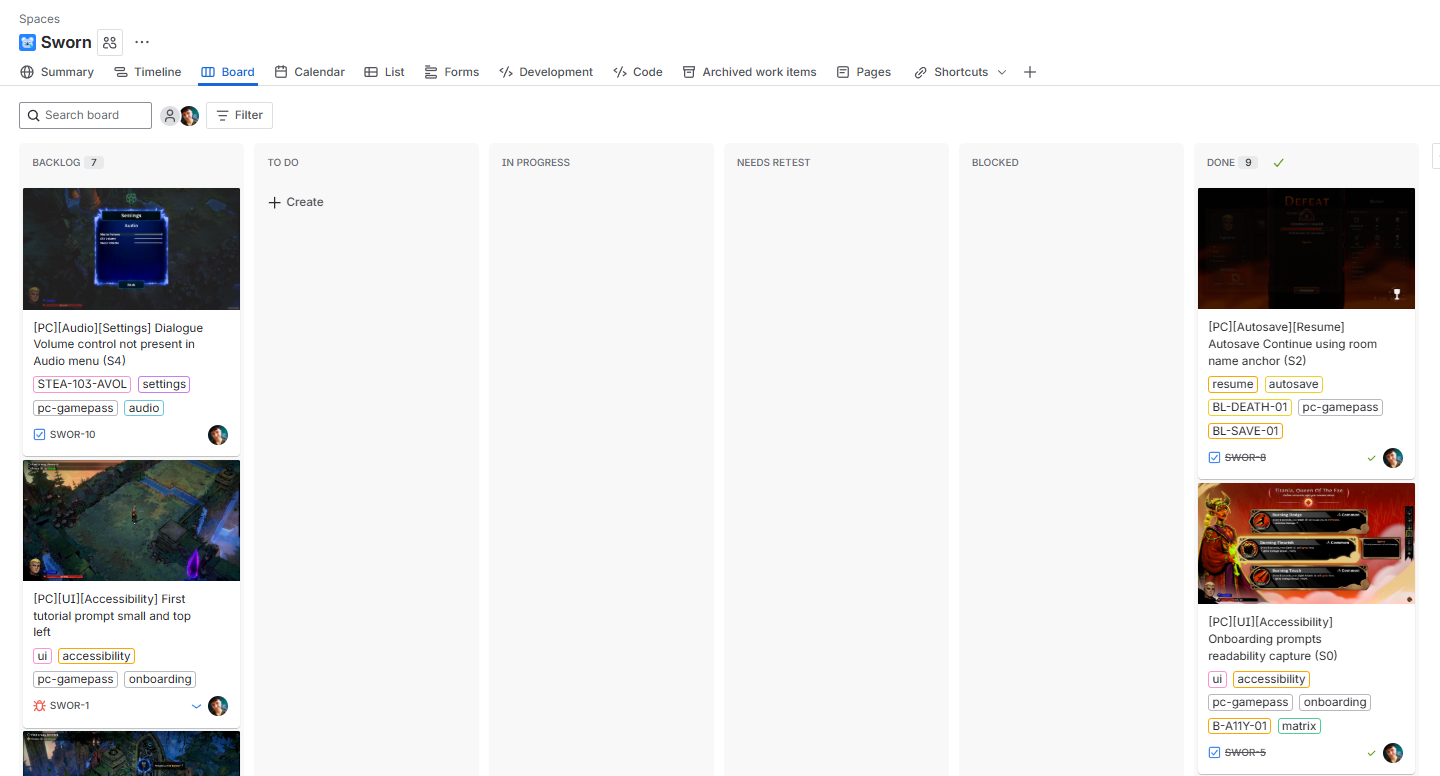
🗂️ Jira Board - Verified Screenshots (thumbnails)
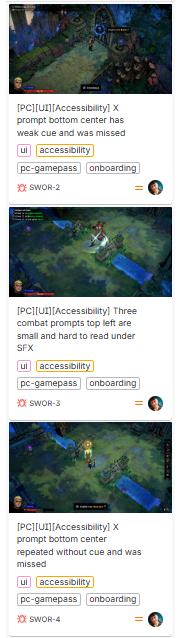
|

|

|
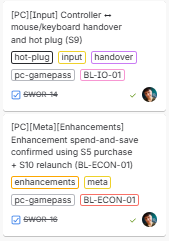
|
Click any thumbnail to view the full-size image.
🗂️ Jira - Bug Ticket Layout
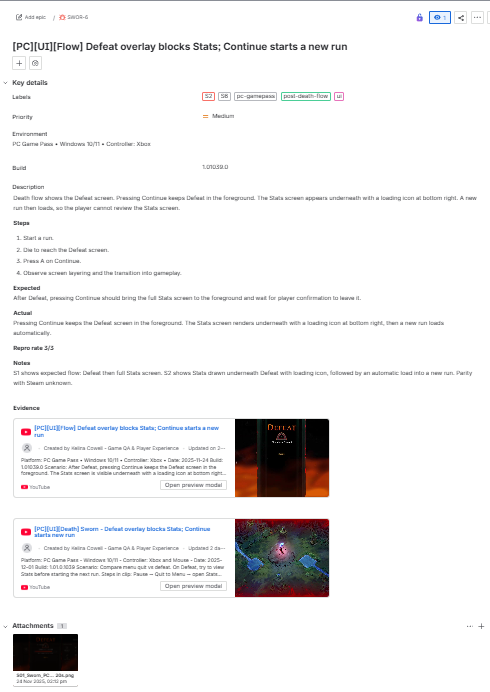
|
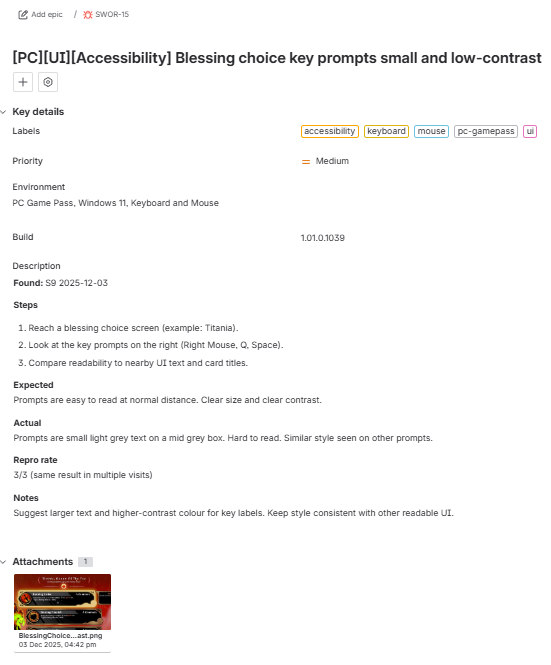
|
Click thumbnail to view the full-size image.
🐞 Bugs – Summary + Screenshots
| ID | Title | Sev | Repro | Screenshot |
|---|---|---|---|---|
| SWOR-1 | [PC][UI][Accessibility] First tutorial prompt small and top left | Low | 3/3 |
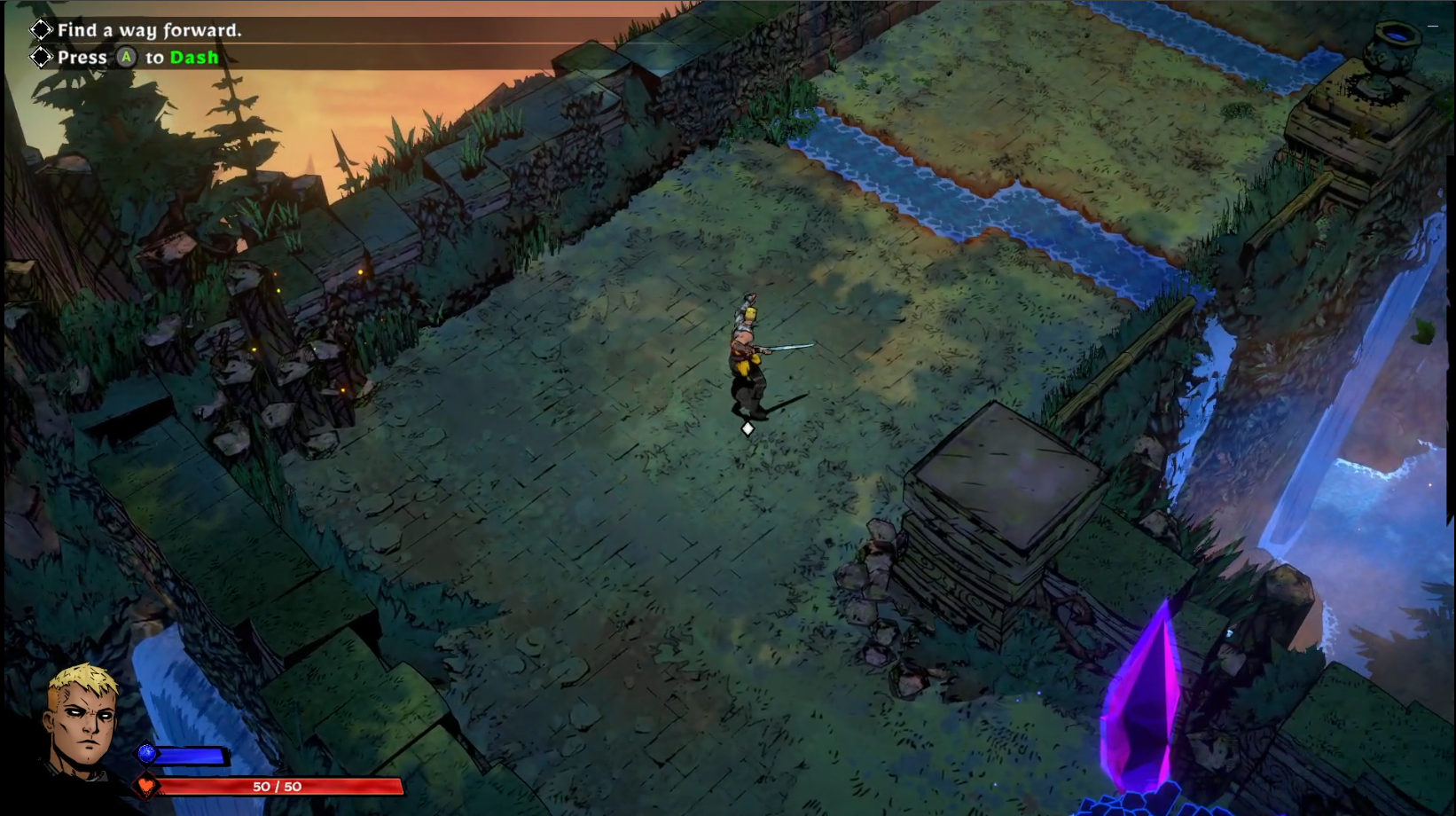
|
| SWOR-2 | [PC][UI][Accessibility] X prompt bottom center has weak cue and was missed | Medium | 3/3 |
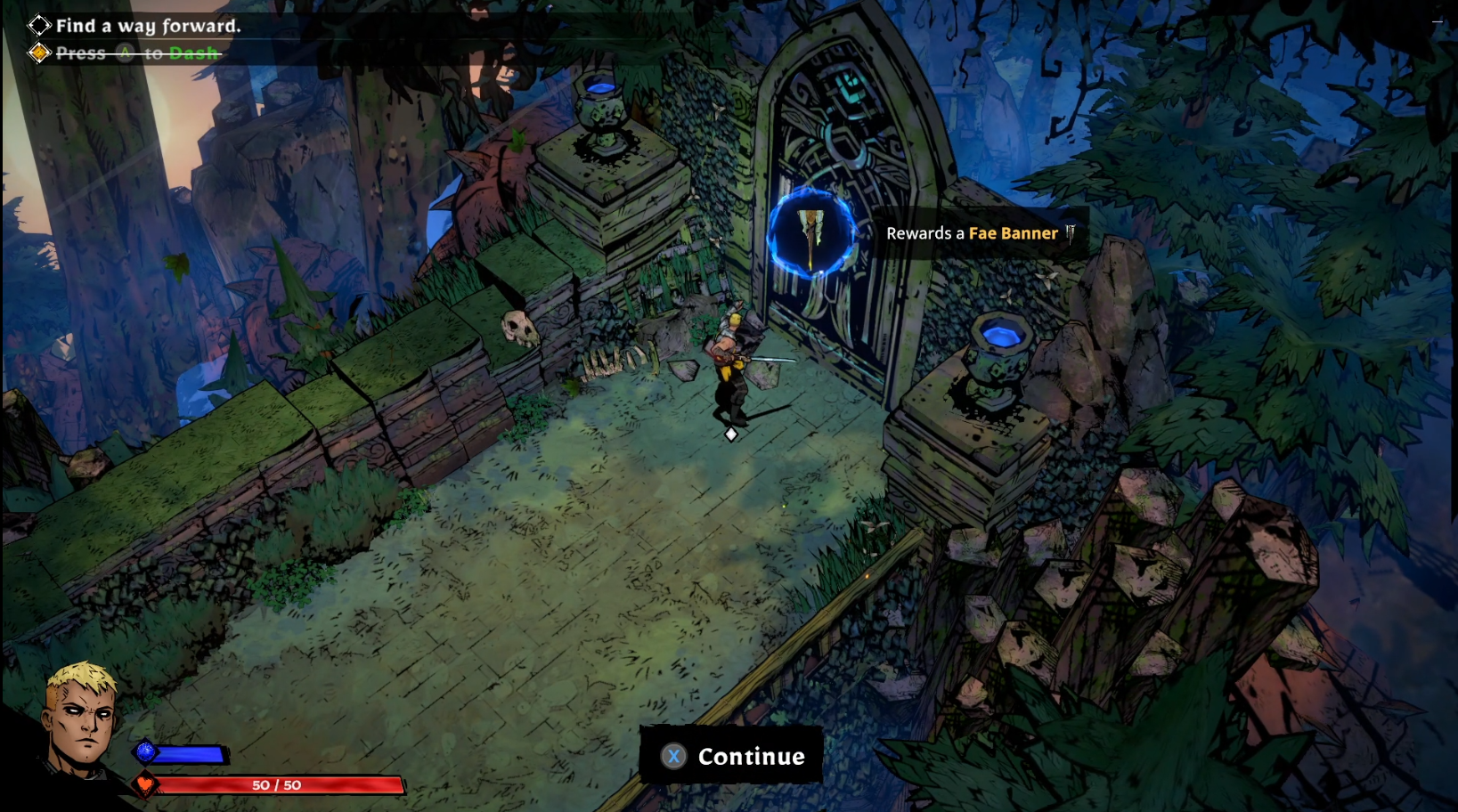
|
| SWOR-3 | [PC][UI][Accessibility] Three combat prompts top left small and hard to read under SFX | Medium | 3/3 |
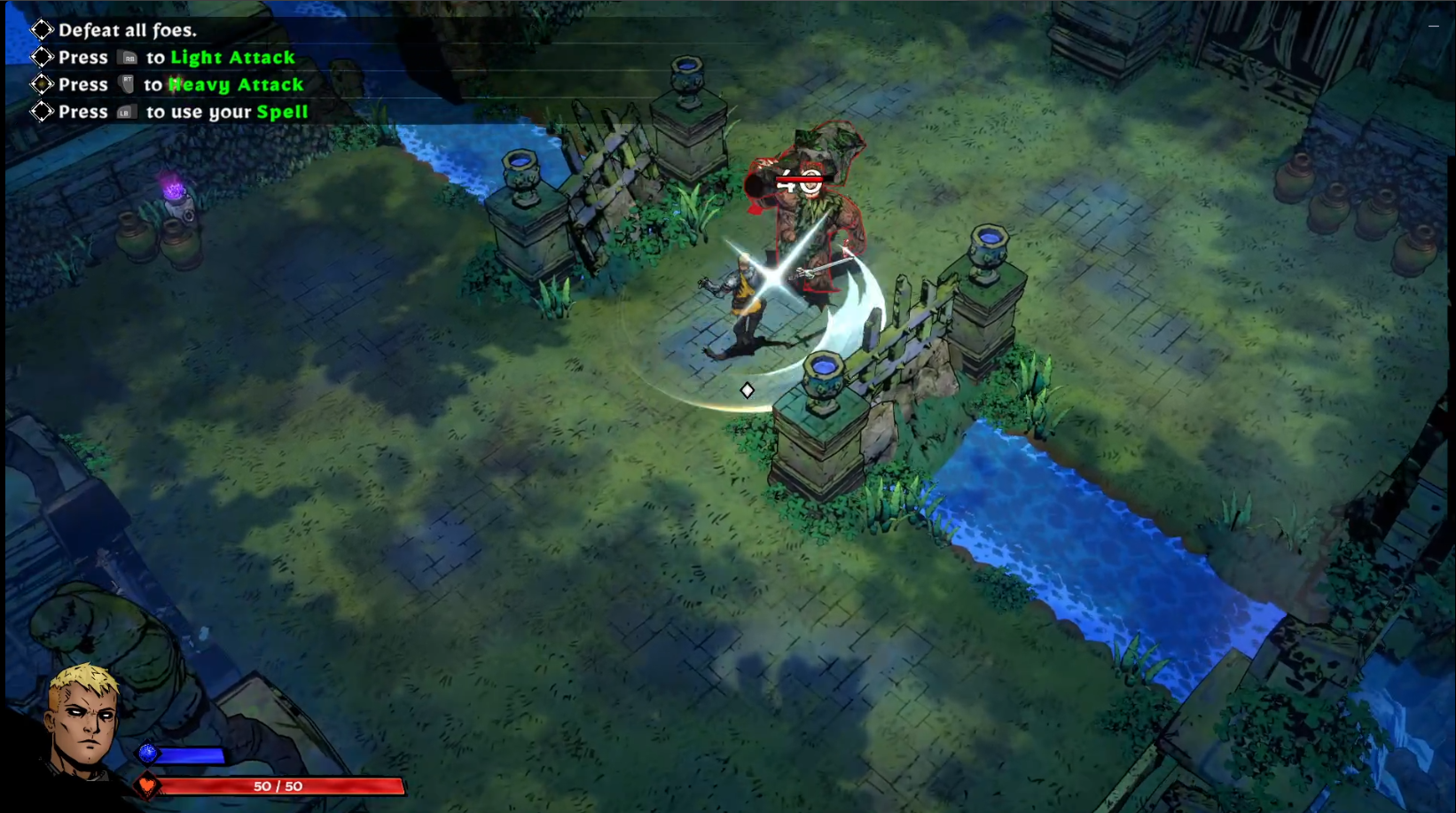
|
| SWOR-4 | [PC][UI][Accessibility] X prompt bottom center repeated without cue and was missed | Medium | 3/3 |
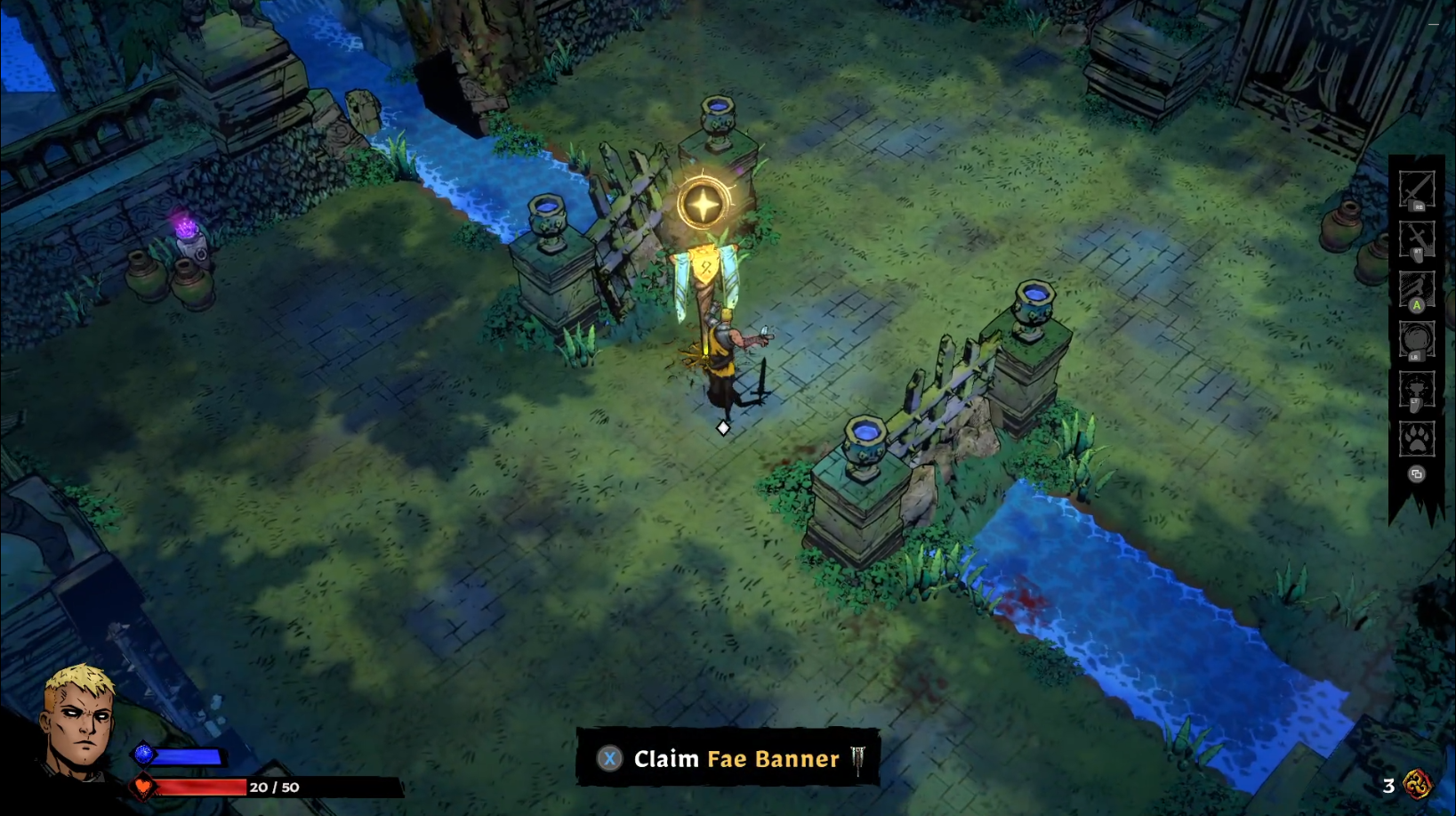
|
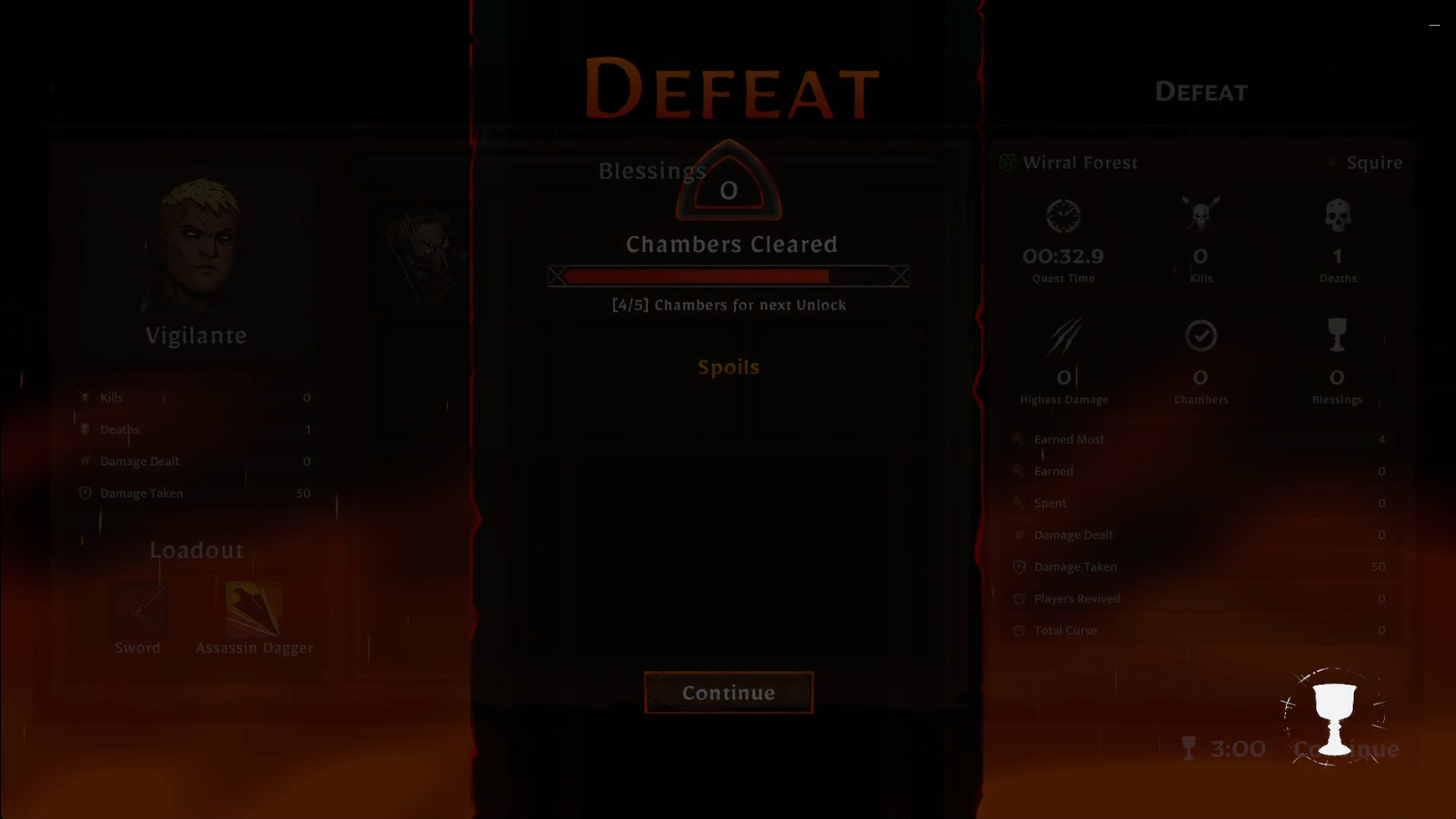
| SWOR-6 | [PC][Death Flow][UI] Defeat overlay remains foregrounded and blocks Stats; Continue starts new run | Medium | 3/3 |
|
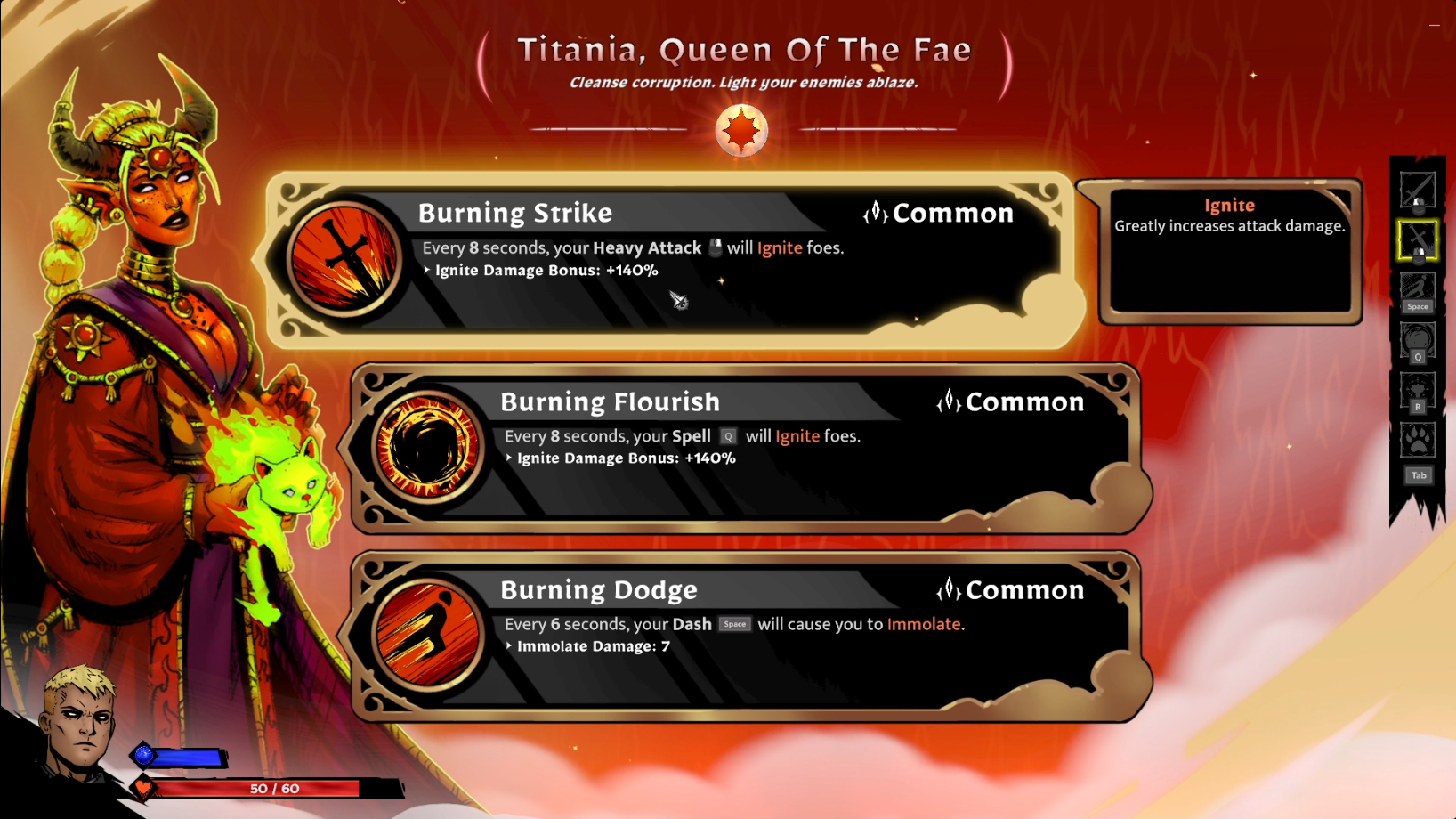
| SWOR-15 | [PC][UI][Accessibility] Blessing choice key prompts small and low-contrast | Medium | 3/3 |
|
📈 Results
- Completed all planned regression checks on the PC Game Pass build with no crashes or instability across the golden path (launch → play → quit → relaunch).
- Logged six defects in total: four onboarding A11y prompt issues (SWOR-1–SWOR-4), one medium-severity death-flow defect (SWOR-6), and one medium-severity Blessing choice readability issue (SWOR-15). All six reproduced consistently (3/3) and are documented with screenshots or video.
- Confirmed core systems behaved as expected: autosave Continue, settings navigation and persistence, audio continuity, Enhancements and Codex behaviour, power-up effects, pause menu, Alt+Tab, and controller↔KBM handover with one hot plug.
- Death-flow defect (SWOR-6): the Defeat overlay remains foregrounded after death, blocking the Stats panel. Pressing Continue immediately starts a new run. Reproduced reliably and captured on video.
- Blessing prompt readability (SWOR-15): Blessing choice key prompts appear extremely small with low contrast. Logged as a medium-severity A11y/UI issue due to readability impact.
- Onboarding A11y prompt cluster (SWOR-1 → SWOR-4): small, low-cue, and easy-to-miss tutorial prompts were still present. These were originally identified on Day 0 and are treated as a known cluster on this build because no newer build was available for re-testing.
- Dialogue Volume setting: this setting appears in upstream patch notes but is not present on the PC Game Pass build. Marked as “Not applicable” rather than a defect.
- General stability: no stutters, hitches or progression blockers occurred during any run. All sessions cleanly returned to main menu and relaunched without issue.
See Metrics above for the full table of runs and references.
🏁 Result and takeaway
Result: The PC Game Pass build of Sworn remained stable across all golden-path and targeted regression checks. Six defects were logged in total: four onboarding accessibility prompt issues (SWOR-1–SWOR-4), one medium-severity death-flow defect (SWOR-6), and one medium-severity Blessing choice readability issue (SWOR-15). All reproduced consistently and are fully documented with evidence.
Takeaway: Sworn’s core systems are generally robust, but UI readability and onboarding prompt visibility need attention, especially for accessibility. The death-flow defect (SWOR-6) is the highest-impact issue and should be prioritised, while the A11y cluster highlights the need for clearer tutorial cueing in early game moments.
🧠 What I learned
- Controlled scope keeps regression useful. Mapping checks to patch-note items or clear risk areas stopped this from becoming a blurry re-test of the whole game.
- The Regression Matrix should do the heavy lifting. Being explicit about expected vs actual outcomes turned the STAR summary into simple reporting instead of reconstruction.
- Patches don’t live in isolation. Feedback from a senior QA manager reinforced that regression shouldn’t stop at confirming patch-note items. In this project I focused on patch-note coverage and baseline risks; in future passes I’ll expand the matrix with planned adjacency sweeps to look for side effects in neighbouring systems.
- Short, purposeful evidence beats long recordings. Tight clips of the golden path, key menus and the death-flow defect (SWOR-6) made review quick and kept the workbook readable.
- Readability issues aren’t cosmetic. The Blessing choice prompts (SWOR-15) showed how low-contrast, cramped UI slows decision-making and can exclude players who need clear visual cues.
- Dyslexia surfaces UX problems early. Dense text and cramped layouts in Enhancements and the Codex stood out immediately, which helped frame these issues as accessibility risks, not just “polish”.
- Admin should help, not hinder. Simple IDs and a single source of truth in the workbook made the project easy to pick up, maintain and audit.
🔚 Conclusion
One-week, change-driven regression pass completed on Sworn (PC Game Pass). The project remained tightly scoped to patch-note-driven checks and baseline stability on the current build. All regression sessions were completed without crashes, and the core golden path remained stable throughout the week.
- Coverage delivered: launch → play → quit → relaunch golden path, autosave Continue behaviour, settings navigation and persistence, audio continuity, Enhancements and Codex readability, power-up behaviour, death-flow logic, pause and Alt+Tab checks, and controller ↔ keyboard/mouse handover including one hot plug. Four onboarding accessibility prompt issues (SWOR-1–SWOR-4) were tracked as a known A11y cluster on this build because no updates were available to verify fixes.
- Highest-impact findings: SWOR-6 - Defeat overlay remains foregrounded after death, blocking the Stats breakdown and causing Continue to start a new run. SWOR-15 - Blessing choice key prompts are very small and low-contrast, creating an accessibility risk. Together with the onboarding A11y cluster, these findings highlight that readability and prompt visibility are the main UX concerns on this build.
- Evidence maturity: Every check is backed by a Regression Matrix entry, Session Log, short focused video or screenshot evidence, and clear Jira-style bug and STAR summaries. The workbook forms a single, fully traceable source of truth for the entire regression week, showing how each conclusion was reached.
Up next: I am moving on to my dedicated VR Comfort & Accessibility case study on Shadow Point (Quest 3). This project focuses on micro-judder and comfort checks, tracking stability, guardian/boundary behaviour, text and UI readability in VR, and how comfortable it feels to play on a standalone Quest 3 over longer sessions. I’ll be using a simple comfort/test matrix and Quest capture to document comfort ratings, accessibility risks, and any interaction or readability issues that only show up in-headset.
Email Me Connect on LinkedIn Back to Manual Portfolio hub
📎 Disclaimer
This is a personal, non-commercial portfolio for educational and recruitment purposes. I’m not affiliated with or endorsed by any game studios or publishers. All trademarks, logos, and game assets are the property of their respective owners. Any screenshots or short clips are included solely to document testing outcomes. If anything here needs to be removed or credited differently, please contact me and I’ll update it promptly.